Choosing the right firewall is essential for maintaining network security, performance, and scalability. Today’s businesses need more than traditional perimeter protection. They require advanced threat detection, secure remote access, application control, and reliable VPN performance.
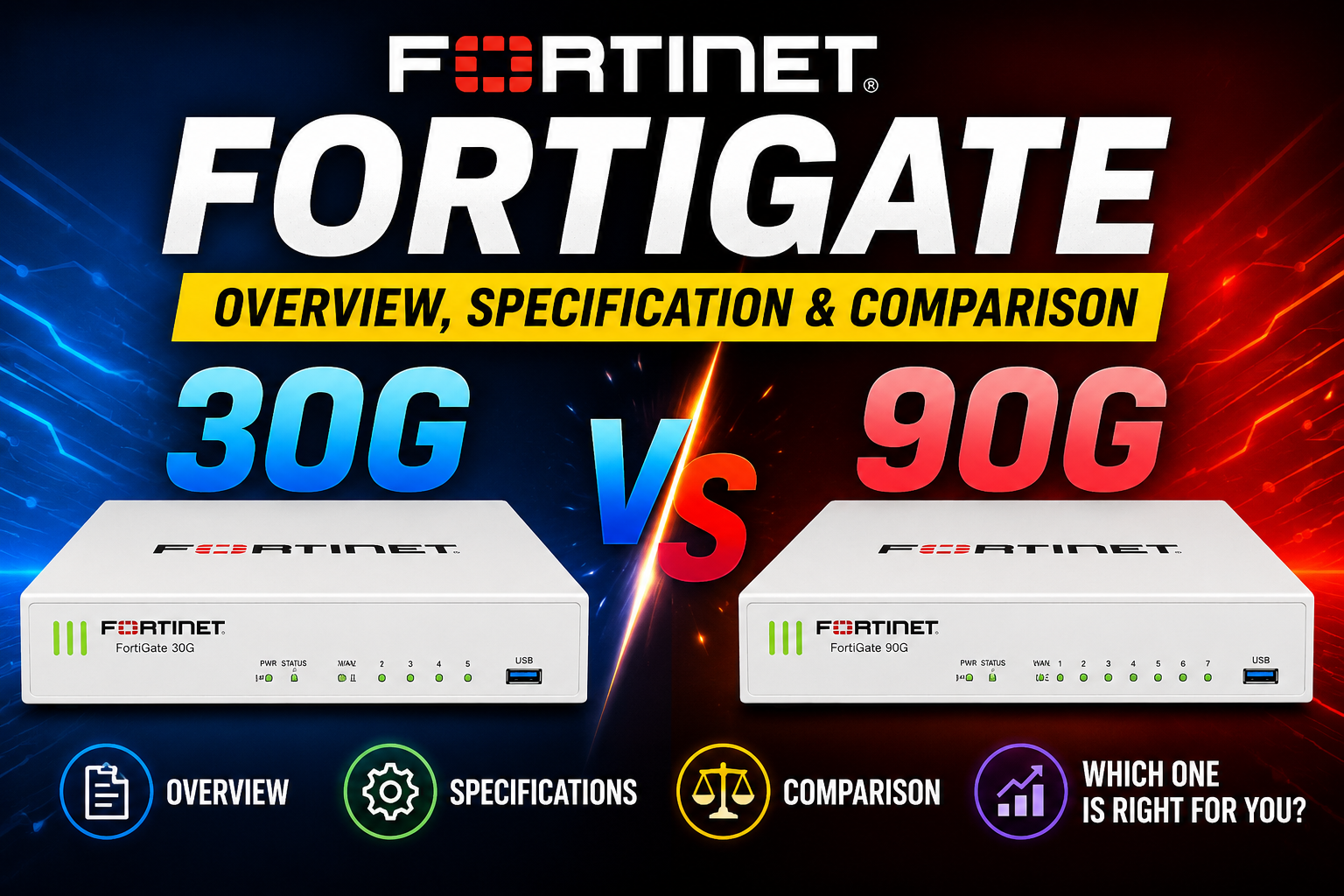
Two popular options in Fortinet next-generation firewall portfolio are the FortiGate 30G and FortiGate 90G. While both devices deliver enterprise-grade protection, they are designed for different environments and business requirements.
In this Article, we compare the Fortinet FortiGate 30G vs 90G, covering overview, specifications, performance, sizing, recommended use cases, and key differences to help you make the right buying decision.
What Is FortiGate 30G?
The Fortinet FortiGate 30G is a compact next-generation firewall (NGFW) designed for small offices, branch locations, retail stores, and remote work deployments.
Built on Fortinet’s security architecture, the Fortigate 30G firewall combines firewall protection, IPS, antivirus, web filtering, VPN, and application control into a single platform.
The Fortinet FG 30G is designed for organizations that need enterprise security without investing in oversized hardware.
Features of Fortinet FortiGate 30G
- Next-Generation Firewall protection
- Secure SD-WAN support
- IPS and malware protection
- SSL VPN & IPsec VPN
- Web filtering and application control
- Cloud-managed security options
- Compact deployment footprint
Many buyers researching Fortinet 30G specs look for a balance between affordability, security, and ease of deployment for small business networks.
Users frequently search for Fortinet 30G WiFi capabilities. Depending on the model variant, wireless functionality or wireless integration options may be available for organizations looking to combine networking and security in a simplified setup.
What Is FortiGate 90G?
The FortiGate 90G is a high-performance Next-Generation Firewall (NGFW) designed for growing businesses, distributed enterprises, and organizations with heavier traffic requirements.
The 90G firewall Fortigate appliance delivers significantly higher throughput, stronger inspection performance, and larger session capacity than entry-level models.
The Fortinet FortiGate – 90G Next Generation Firewall (NGFW) is commonly used in:
- Mid-sized businesses
- Corporate branch offices
- Multi-user environments
- Cloud-connected organizations
- Security-focused enterprise deployments
Compared to smaller appliances, the FortiGate 90G is engineered to support more users, more devices, and heavier encrypted traffic workloads.
Fortinet FortiGate 30G vs 90G: Specification Comparison
| Specification | FortiGate 30G | FortiGate 90G |
|---|---|---|
| Deployment Size | Small Office / Branch | Mid-Size Business / Enterprise Branch |
| Security Type | Next-Generation Firewall | Next-Generation Firewall |
| Performance Level | Entry-Leve | High Performance |
| VPN Support | Yes | Yes |
| SD-WAN | Supported | Supported |
| SSL Inspection | Standard | Advanced |
| User Capacity | Small Size | Large Organization |
| Traffic Handling | Moderate | High Volume |
Final Thought
Both the Fortinet FortiGate 30G and FortiGate 90G deliver powerful next-generation security capabilities, but they target different business needs.
The Fortinet FG 30G is optimized for small offices, branch locations, and businesses needing compact, cost-effective protection.
The FortiGate 90G, on the other hand, is designed for organizations requiring stronger performance, greater scalability, larger user capacity, and advanced traffic inspection.
If your priority is small-business security and simplified deployment, the Fortigate 30G may be the right fit.
If your organization needs higher throughput, future scalability, and enterprise-grade performance, the FortiGate 90G is likely the better investment.
You might be interested this products:
Fortinet FortiGate 80F Next-Gen Firewall | FG-80F Appliance Only
FortiGate 90G FG-90G Firewall – 8 GE & 2 10GE WAN Ports | High-Speed Secure NGFW
FortiGate 30G Firewall FG-30G – 4 GE Ports, VPN & NGFW for Small Businesses
Comments are closed